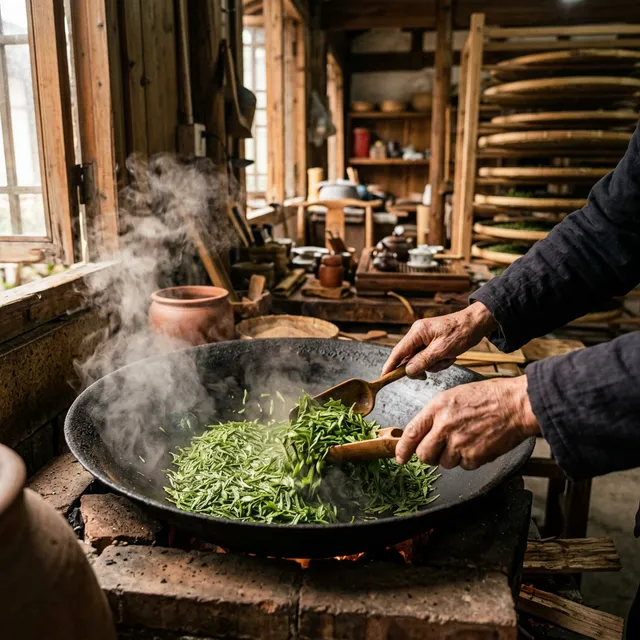
I have held a lot of beautiful things in my hands. But nothing quite prepared me for the first time I pressed my palm against a cast-iron wok in a Hangzhou tea workshop, feeling the dry heat rise against my skin while a master tea farmer guided the leaves in slow, deliberate circles. In that moment — surrounded by steam that smelled like warm chestnut, cut grass, and something almost floral — I understood everything about what we were trying to bottle.
That experience became the architecture of our Chasense Spring Tea fragrance. But to explain why it moved me so deeply, I have to take you back. Way back. Over a thousand years, to a hillside village on the edge of West Lake.
Where the Dragon Wakes
West Lake Longjing — or Xihu Longjing — is not simply a tea. It is one of the oldest continuously cultivated agricultural products in human history, with roots stretching back more than 1,200 years to the slopes of Hangzhou, Zhejiang Province. The region's misty mornings, acidic soil, and moderate temperatures create a micro-climate so precise that the same cultivar grown even fifty kilometers away produces an entirely different cup. This is why origin is everything with Longjing. The terroir is not marketing language — it is biochemistry.
The earliest documented reference to tea from this region comes from the Tang Dynasty (618–907 CE), when the great tea scholar Lu Yu catalogued it in his landmark text, Cha Jing — The Classic of Tea. But it was during the Song Dynasty (960–1279 CE) that Longjing began its ascent from local curiosity to national obsession. Monks at the temples near Shifeng Mountain cultivated it as a meditative practice. Poets drank it as a muse. And the name itself — Dragon Well — traces to an ancient legend: a dragon residing in the nearby well that, when it moved, brought life-giving rain to the parched hills. Tea grown here, the villagers believed, carried the dragon's breath.
The Emperor's 18 Trees
No story shapes the mythology of Longjing more powerfully than that of Emperor Qianlong.
In 1751, the Qing Dynasty emperor — arguably the most culturally influential ruler in Chinese history — made the first of six pilgrimages south of the Yangtze River. At Hu Gong Temple near Lion Peak Mountain (Shifeng Shan), he was offered a bowl of freshly picked Longjing. He was so moved that he personally bent down among the tea bushes and picked leaves with his own imperial hands. The story goes that he carried those leaves back to Beijing tucked in his sleeve — still warm, still fragrant — and his ailing mother, the Empress Dowager, had them brewed on the spot. She recovered. Qianlong, in gratitude and wonder, conferred imperial status on the 18 tea bushes from which he had picked, designating them Gong Cha — tribute tea reserved exclusively for the Forbidden City.
Those 18 trees still stand today beside Hu Gong Temple. The tea they produce now sells for more per gram than gold. I have stood in front of them. The leaves are no different in appearance from their neighbors. But the weight of history around them is something you feel in the chest.
Four Virtues of a Single Leaf
Before we ever talk fragrance, we must talk about what makes a Longjing leaf singular. Master tea producers grade Longjing against four qualities, poetically rendered in Mandarin: lü (green), bian (flat), xiang (fragrant), and nong (mellow). Every step of production is engineered to protect all four simultaneously — and that tension is where the art lives.
The harvest window is brutally narrow. The finest grade, Mingqian (Pre-Qingming), is picked before the Qingming Festival in early April — sometimes as early as late March — when the buds are still just a single tight curl. A skilled picker harvests only the most tender shoot: one bud, one leaf, selected by hand. On a full harvest day, one person might pick enough leaves to produce just 50 grams of finished tea. Every single cup of premium Longjing you have ever held represents hours of human attention.
The Alchemy of Fire and Hand
This is where the story becomes a sensory one. And this is where I found the fragrance.
After harvest, the fresh leaves are spread thin on bamboo trays and allowed to wither in open air for several hours — a process called tan qing, or "cooling spread." This step is not passive. Moisture releases. Enzymatic activity begins. The raw, grassy sharpness of the just-picked leaf starts to soften.
Then comes the pan-firing — sha qing, meaning "killing the green" — and it is unlike anything else in the tea world.
A large cast-iron wok is heated to between 80 and 100°C. The tea master lifts a handful of wilted leaves and places them directly against the dry, smoking surface. Then, using bare hands, they begin: pressing, sliding, shaking, tossing in one continuous rhythmic motion that never stops for the next twelve to fifteen minutes. The pressure shifts from light to heavy. The pace adjusts to the temperature. A master reads the leaves the way a musician reads sheet music — by feel, by sound, by the way the steam changes.
This step does two things simultaneously. First, it halts oxidation by destroying the enzymes that would otherwise turn the leaf brown — locking in that signature jade-green color. Second, and more crucially for us as fragrance makers, it transforms the aroma. The raw, sharp vegetal notes of the fresh leaf are replaced by something more complex: warm chestnut, toasted orchid, sweet hay, a trace of something almost buttery. The heat does not destroy fragrance — it creates it.
Scientific analysis of Longjing's volatile compounds reveals why. The dominant aromatic molecule in Longjing is geraniol — a terpene alcohol that carries a rosy, slightly sweet floral quality. It is accompanied by linalool, which adds a soft lavender-like warmth; β-ionone, which reads as violet and woody; and nonanal, which contributes a waxy, clean creaminess. These are not accidental. They are produced and concentrated through the specific thermal reactions of pan-firing. Change the temperature by ten degrees; change the scent entirely.
What I Smelled in That Wok
When I describe the scent of pan-fired Longjing to people who have never experienced it, I tell them this: imagine standing in a garden on the first genuinely warm morning of spring. There is dew on the grass. Someone nearby is roasting hazelnuts over a wood fire. And just behind you, a jasmine vine is catching the last of the night's coolness before the sun reaches it.
That is Longjing in its moment of transformation.
The fragrance is not tea the way most people imagine tea — it is not the aqueous, slightly tannic quality of steeped leaves in a cup. It is something drier, more mineral, more alive. It has height and depth at the same time. The top of the scent lifts green and bright; the base is toasty and grounded. In perfumery terms, Longjing occupies a rare tonal register that bridges the fresh aromatic and the warm oriental families — which is exactly what makes it such a demanding and rewarding material to build around.
Translating a Ritual into a Bottle
Designing a fragrance inspired by Longjing and designing a fragrance that smells like brewed tea are two entirely different briefs — and confusing them is how you end up with something that smells like a teabag.
Our Chasense Spring Tea fragrance was built around the moment of pan-firing, not the cup. We wanted to capture the heat, the hand pressure, the release of steam carrying roasted terpenes into cool morning air. That specific window — five minutes into the firing when the moisture has left but the transformation is not yet complete — is what we were chasing.
Experience the Ritual: Chasense Spring Tea (Longjing)
Our award-winning flagship fragrance, capturing the exact moment of pan-firing in a Hangzhou valley.
Check PriceThe architecture of the fragrance follows the same logic as the tea itself:
- Top notes open with a crisp green brightness — bergamot and fresh-cut grass — echoing the raw leaf before it meets the wok
- Heart notes carry the transformation: a warm geraniol-driven floral accord layered with toasted rice and a whisper of jasmine, mirroring the chemical reality of pan-firing
- Base notes settle into the dry, mineral warmth of the wok itself — sandalwood, white musks, and a subtle oakwood drydown that extends the scent's meditative quality
The result is not a tea perfume. It is a tea ceremony perfume. The difference is time — it unfolds the way a ritual unfolds, with intention and patience.
The Living Legacy of Longjing Village
It matters that the 18 imperial tea trees Qianlong designated in the 18th century are still alive and still producing tea. It matters that skilled tea masters still fire their leaves by hand despite mechanization being far more efficient. These facts are not nostalgia — they are a philosophy. Longjing has survived over a millennium because each generation understood that the value of the product is inseparable from the value of the process.
That is the principle we carry into every Chasense fragrance we make. Not the shortcut. The ritual.
Why Spring Tea Exists
Every fragrance tells you something about its maker's obsessions. Chasense Spring Tea is the distillation of mine: the conviction that the most sophisticated scents are not built in laboratories from abstract molecules — they are found in specific moments of human craft, in the gap between raw material and finished beauty, in the place where a master's bare hands meet a hot iron surface at 4 AM in a Hangzhou valley.
Longjing taught me that the finest things in the world are made under pressure, with precision, in narrow windows of time. That freshness and warmth are not opposites — they are partners. That a scent can carry not just a smell, but a posture: unhurried, attentive, fully present.
That is the ritual of Longjing. That is Spring Tea.
Chasense Spring Tea is available as an Eau de Parfum. Crafted in small batches. Inspired by the pan-fired heart of West Lake Dragon Well tea.