There is a moment — fleeting, almost sacred — when you uncap a vial of freshly extracted white tea absolute and the entire memory of a mountainside in Fujian Province pours into the room. That moment is why I do this work.
I've spent years standing between two worlds: the ancient tea gardens of China and the precision laboratories where modern perfumery is born. Working alongside Firmenich — one of the world's foremost fragrance ingredient companies — has taught me that capturing Chinese tea in a bottle isn't chemistry alone. It's cultural translation, botanical patience, and an obsession with truth.
This is the story of how we do it.
The Garden Is the Lab
Before a single molecule is extracted, we begin at the source. China's tea heritage is the richest on earth — six foundational categories of Camellia sinensis leaf, each transformed by fermentation, oxidation, and terroir into something wholly distinct. Green tea carries a brisk freshness and chestnut-like character; oolong sits in a complex middle ground with floral and fruity depth; black tea tilts toward sweet, fermented warmth; and rare white tea — barely touched after harvest — offers something rosy, tender, and ethereal.
Each of these olfactory personalities demands a different approach in the lab. You cannot treat a Silver Needle white bud the same way you treat a heavily roasted Wuyi oolong from the cliffs of Fujian. The leaf itself tells you how it wants to be handled.
My sourcing partners at Firmenich work directly with farmers in China's mountainous growing regions, where leaves are hand-picked during precise seasonal windows stretching from March through September. Timing matters enormously. The first flush of spring carries the highest concentration of volatile aromatic compounds — the molecules that will ultimately become a Chasense fragrance.
The Ancient Art Behind the Modern Bottle
Tea has been central to Chinese olfactory culture for millennia. Long before HPLC chromatography existed, Song Dynasty perfumers were documenting scent recipes with the same reverence we now apply to molecular analysis. When Firmenich opened Villa Harmony in collaboration with Shanghai's Xun Laboratory — a research studio rooted in Chinese perfumery history — the opening ceremony honored that lineage by lighting an incense burner using the ancient scent formula "Baozhuan," documented in the Song Dynasty.
That ceremony wasn't theater. It was a reminder that the fragrances we create today inherit thousands of years of olfactory wisdom. Xirui Ma, head of Xun Laboratory, described the collaboration as an effort to "deepen our understanding of Chinese perfumery, including its formulations, processing techniques and scent aesthetic using today's science and technology." That ethos is exactly what guides our work at Chasense in the extraction room.
Three Paths From Leaf to Essence
Getting the soul of a Chinese tea into a wearable fragrance requires choosing the right extraction method. Each pathway reveals different facets of the same leaf.
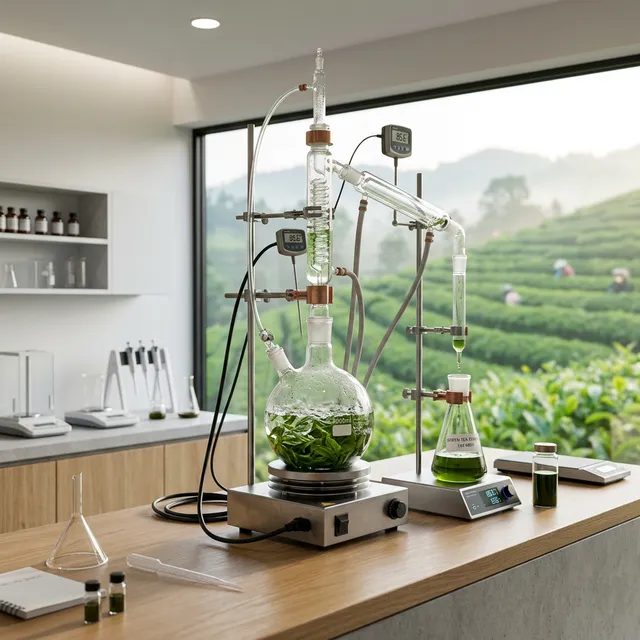
Steam Distillation is the most classical route. Live steam passes through dried or fresh tea leaves, coaxing the volatile aromatic compounds upward. As the steam condenses, the essential oil separates from the water below, delivering a fresh, herbal, and sometimes lightly smoky profile — particularly effective for green teas that live and die by their grassy immediacy.
Solvent Extraction suits the more delicate varieties. When we work with white tea — whose aroma whispers rather than shouts — chemical solvents draw out a richer, more complete absolute. The resulting material holds the full spectral range of the leaf, from the subtle top florals to the deeper, darker earth tones underneath. This is how you capture the famous rosy-green delicacy of Bai Hao Yin Zhen, the Silver Needle.
Supercritical Fluid Extraction (SFE) is where science and artistry converge most dramatically. Firmenich has been a pioneer in SFE technology for over three decades. The process transforms CO₂ beyond its critical point — a state where it behaves as neither liquid nor gas — and diffuses it through the tea leaves at low temperatures, pulling out aromatic compounds without the heat that would degrade them. The result is an extract of exceptional purity and fidelity.
The SFE process preserves all the facets and the natural profile identity to guarantee a high purity extract. — Firmenich product documentation
Firmenich's Tea White China SFE, for example, is sourced exclusively from Chinese gardens and produces an olfactive description the company calls "aromatic, fruity, herbaceous — a delicately aromatic green and fruity tone, tinted with slightly floral-fresh facets." When I first smelled it straight from the vial, it was like holding a porcelain cup of first-flush Longjing in both hands.
What Each Tea Variety Smells Like (And Why It Matters for Chasense)
Understanding the olfactory fingerprint of each tea type is essential before a single drop enters a Chasense composition.
| Tea Type | Key Aroma Markers | Extraction Method | Perfumery Role |
|---|---|---|---|
| Green Tea | Fresh, grassy, chestnut, linalool-rich | Steam distillation | Top/heart; opens with luminous clarity |
| White Tea | Rosy, tender, floral-green, delicate | Solvent extraction / SFE | Heart; projects softness and refinement |
| Oolong Tea | Floral, fruity, roasted, complex | SFE / absolute | Heart/base; bridges florals and woods |
| Black Tea | Sweet, fermented, warm, smoky | Solvent extraction | Base; adds depth, earthiness, longevity |
| Jasmine-Scented Tea | Floral, sweet, sambac jasmine + tea tannin | SFE | Heart; layered floral-tea accord |
Oolong is arguably the most challenging and the most rewarding material I've worked with. It's superbly viscous, surprisingly easy to overpower, and yet when dosed correctly, it creates a "tannic tang" that marries beautifully with white florals and grounding vetiver. The floral notes in oolong come primarily from linalool oxides and geranyl esters, compounds formed during the tea's semi-oxidation process — giving it a distinctly different floral character from rose or jasmine.
Experience Oolong Complexity: Chasense Comforting Oolong
Our oolong fragrance captures the honeyed, floral depth of partially oxidized tea with osmanthus and warm amber.
Check PriceReading the Past With Modern Technology
One of the most powerful tools in our collaboration with Firmenich is Natureprint — a proprietary analytical technology that allows perfumers to decode the precise chemical composition of a scent, including ancient or historically documented fragrances. Applied to Chinese tea and incense traditions, Natureprint lets us analyze what made a 12th-century Song Dynasty tea ceremony smell the way it did, and then reconstruct those molecular signatures with modern ingredients.
This bridges the gap between cultural preservation and contemporary wearability. When we studied olfactory records from the Tang and Song Dynasties, we found that incense-burning, tea ceremony, and personal perfumery were deeply intertwined — agarwood, sandalwood, and tea notes layered together in a ritual of combined sensation. Those ancient accords now inform how we build base notes in a modern Chasense tea fragrance: the smoke underneath the leaf, the wood beneath the steam.
The Science of Softness: Chasense Zentea Qing
Designed with Firmenich's high-purity green tea extracts for a crisp, linen-like meditative profile.
Check PriceThe Composition Process: Building From the Ground Up
When I sit down to build a Chasense tea fragrance composition, I don't start with the tea. I start with silence. I think about the specific moment — the experience — I want to recreate. Is it the contemplative solitude of a gaiwan ceremony in a Beijing courtyard at dawn? Or the social warmth of a Fujian oolong tasting poured across a worn wooden table?
The structure follows:
- Base notes are laid first — sandalwood, vetiver, or oud to anchor the composition and provide longevity. These also echo the wooden furniture and aged clay of a traditional teahouse
- Heart notes carry the actual tea extract — white tea SFE, oolong absolute, or a jasmine tea accord — supported by complementary florals like osmanthus or magnolia that grow naturally alongside Chinese tea gardens
- Top notes set the initial impression — bergamot or petitgrain to brighten the opening, before the tea's true character emerges beneath
- Harmony checks happen after every single addition. Natural extracts are living, variable materials — a shift in the oolong absolute from one harvest to the next can alter the balance of an entire formula
The jasmine-tea accord is a particularly beautiful creation. Traditional Chinese jasmine tea is made by layering fresh green tea leaves with jasmine blossoms over several weeks — sometimes refreshing the flowers daily, using more than 1.1 kilograms of jasmine per kilogram of tea — until the leaves are fully saturated with floral perfume. We replicate that graduated absorption in the lab by building the accord in layers rather than blending everything at once.
Why Authenticity Is Non-Negotiable
There is a growing market for "tea-inspired" fragrances that use synthetic accords to approximate the smell of tea without using any actual tea material. These fragrances have their place. But they cannot do what a properly extracted Chinese tea SFE can do: they cannot carry the specific aromatic signature of a Wuyi cliff oolong grown in iron-rich red soil at 800 meters above sea level. That terroir is invisible to the nose but felt in the composition's complexity.
Firmenich's commitment to authentic Chinese sourcing — building dedicated creative infrastructure in Shanghai, partnering with local experts at Xun Laboratory, investing in culturally grounded co-creation — reflects an understanding that provenance is fragrance. Consumers today, particularly in China's rapidly growing fine fragrance market, are becoming increasingly sophisticated in their ability to detect and reward that authenticity.
The market data bears this out: Chinese fragrance consumers are drawn to compositions that reflect their own olfactory heritage — the smell of a specific type of tea, from a specific province, processed in a specific way. A synthetic accord, however beautifully constructed, cannot anchor that emotional geography. That is why every Chasense fragrance begins with authentic tea extracts.
The Future of Chinese Tea in Perfumery
We are living through a renaissance moment. Ancient Chinese olfactory culture — documented in dynastic texts, preserved in museum collections, encoded in tea ceremony traditions — is being decoded, translated, and worn on skin for the first time in centuries. Firmenich's Natureprint technology is analyzing historical scent records. Xun Laboratory is cataloguing indigenous Chinese fragrance ingredients that global perfumery has never used before. New Chinese niche brands like Chasense are building entire collections around the full spectrum of Camellia sinensis varieties, from Silver Needle white tea to darkly fermented Yunnan pu-erh.
The leaf has always held the fragrance. We are simply learning, with every harvest and every extraction, how to listen.
Every bottle begins in a garden — in the curl of a hand-picked bud, in the morning mist over a hillside, in the specific way a farmer decides which leaves are ready and which need one more day of sun. From that moment of harvest to the moment you press a Chasense fragrance to your pulse point, an entire world travels with it. That is the journey we're committed to making honest.